



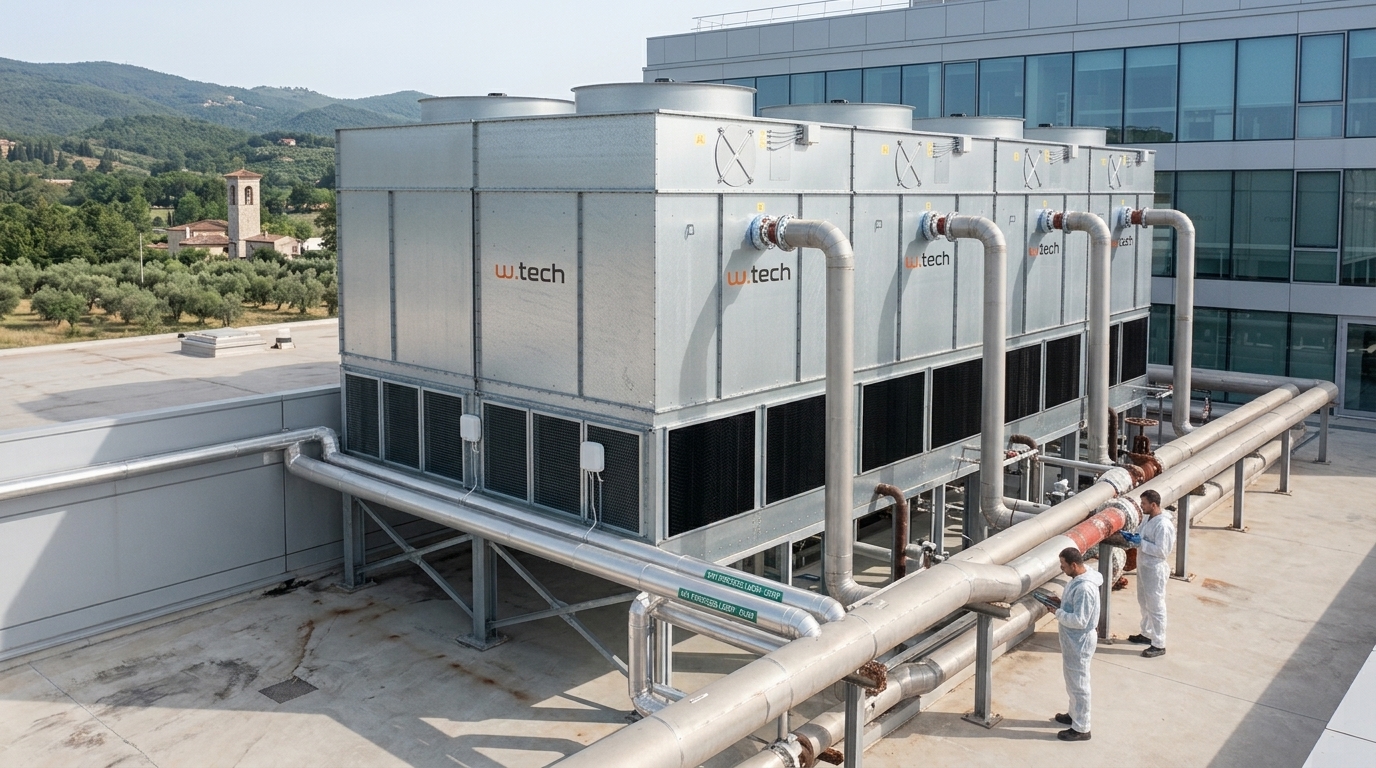
In the pharmaceutical and chemical industries, process cooling is a critical factor that directly affects product quality, operational safety, and regulatory compliance. In these highly regulated sectors, there are no effective off-the-shelf solutions: each plant requires a “tailored” design approach—one that is fully customized to the site’s specific thermal and structural requirements.
When thermal precision is an essential requirement
In chemical and pharmaceutical processes, even the slightest temperature fluctuations can compromise the entire production cycle. Thermal stability directly affects:
- The stability and efficacy of the active pharmaceutical ingredients (APIs).
- The yield and kinetics of chemical reactions.
- Compliance and the quality of the final product.
- The safety of the entire production facility (prevention of uncontrolled reactions).
For this reason, cooling systems (such as chillers or evaporative towers) must ensure high thermal stability, precise and continuous control, and a rapid response to load variations. In such contexts, standardization is not enough: it is custom design that makes the difference.
“Tailored” Approach: Custom System Design
A “tailored” cooling system is not simply adapted from a catalog, but is engineered specifically for the industrial process. This involves a detailed analysis of:
- The specific thermal profile of the chemical or pharmaceutical process.
- Production cycles and sudden changes in thermal load.
- Strict security and redundancy requirements (backup systems to prevent overheating).
- Environmental conditions and water quality at the operational site.
The result is a system that does more than just cool; it integrates seamlessly into the factory’s production process.
The Role of Materials and the Challenge of Evaporative Towers
In the chemical and pharmaceutical industries, the choice of materials plays a crucial role. Corrosion resistance, structural stability, and durability are key to ensuring reliability and operational continuity, especially in the presence of treated water, chemicals, and harsh environmental conditions.
This is precisely why, at W-Tech, we pay special attention to the choice of construction materials: our machines are made of Magnelis®, a steel-based metal alloy with a coating composed primarily of zinc, aluminum, and magnesium, characterized by high corrosion resistance and greater durability even in particularly harsh environments. This choice allows for more effective protection of the machine’s structure, reducing the risk of deterioration over time and the need for extraordinary maintenance.
Evaporative towers, which are key components in process cooling systems, are exposed daily to conditions that can compromise their performance, efficiency, and service life:
- Mineral deposits: caused by lime and sediment, typical of hard water in many industrial areas, such as the Prato district and Tuscany.
- Chemical corrosion: accelerated by pH imbalances or the presence of aggressive chemicals.
- Biofouling and the risk of Legionella: The proliferation of algae and bacteria requires targeted chemical treatments and surfaces and materials that facilitate cleaning and sanitization.
The use of high-performance materials, combined with a design tailored to the site’s operating conditions, therefore helps extend the system’s service life, reduce the risk of downtime, and keep maintenance costs down over the long term.
Reliability and Continuity: The Value of the W-Care System
In the chemical and pharmaceutical industries, operational continuity is an essential requirement. Any plant shutdown can result in significant financial losses and regulatory compliance issues. To protect this investment, W-Tech has developed W-Care, a system designed for structured and predictive maintenance of cooling systems.
Through scheduled maintenance, periodic performance checks, and the integration of IoT monitoring systems(real-time sensors for pH, turbidity, and flow), W-Care ensures that the system maintains its original efficiency throughout its useful life, reducing the total cost of ownership (TCO).
The Impact of Maintenance on the Local Area: The Case of Tuscany
The effectiveness of a structured approach is demonstrated in practice by the data and experiences of areas with a strong industrial focus, such as the Prato district and its surroundings, where thermal management is often challenged by the hardness of the local water:
- Chemical/manufacturing sector in Florence: The implementation of sensor-based predictive maintenance on a 500-kW tower extended the system’s useful life by 5 years, resulting in net savings of approximately €40,000.
- Prato District: Semi-annual chemical cleaning and biofouling control measures have enabled local companies to reduce energy consumption by up to 18%, eliminating the risk of production downtime (which in a dyeing plant or chemical facility can cost thousands of euros per day) and ensuring full compliance with ARPAT guidelines.
Analysis of Maintenance Costs and ROI (Market Forecasts Through 2026)
Investing in a preventive and customized plan pays for itself within 6 to 12 months. Below is an average estimate of the annual operating and maintenance costs for a typical industrial cooling system (approx. 500 kW) in a high-precision environment:
| Type of Work / Maintenance | Estimated Annual Cost (€) | Benefits and Operational Notes |
| Daily Checks and Monitoring | 2,000–4,000 | Conducted by in-house staff / Visual inspection |
| Chemical Treatment and Monthly Cleaning | 5,000–8,000 | pH control, scale inhibitors, and automatic biocides |
| Comprehensive semi-annual/annual maintenance | 10,000–15,000 | Chemical cleaning of fillers, structural inspection |
| Digital Monitoring & IoT W-Care | 3,000 – 6,000 | Advanced sensors, real-time alerts, and predictive analytics |
| TOTAL BUDGET | 20,000 – 33,000 | 15–25% savings on energy consumption |
| Corrective Repair (In the Event of a Failure) | 30,000 – 50,000+ | Emergency costs + losses due to production downtime |
ROI Note: Preventing breakdowns and avoiding extraordinary corrective repairs eliminates the risk of downtime, which, in the chemical and pharmaceutical industry, can easily exceed €1,000 per day in lost productivity alone.
Conclusions
In the pharmaceutical and chemical industries, process cooling cannot be addressed using standardized or off-the-shelf approaches. The complexity of heat transfer and strict regulatory requirements call for custom-engineered solutions.
The winning combination of “tailored” design, the use of corrosion-resistant materials, and an advanced maintenance program such as W-Care enables companies to achieve systems that are highly reliable, safe, efficient, and economically sustainable over the long term.
Would you like to design a custom cooling system or optimize your maintenance plan?
The W-Tech technical team is at your complete disposal to develop customized solutions for the chemical, pharmaceutical, and industrial sectors. Contact us for a personalized consultation.



